


Haiti: A Glimmer of Hope on the Horizon?
Sunday, November 15, 2026 - [click here to support the continuing work at MOHI]
Today's update is from Jonathan and Taran
There are moments when the challenges around us can seem overwhelming. When the needs are greater than the resources available, when circumstances seem beyond our control, and when we find ourselves wondering what tomorrow will bring.
For our friends in Haiti, this has been a daily reality for far too long.
And yet, even in the middle of uncertainty, we continue to see God's faithfulness.

Jesus understood that people have physical needs. He had just fed thousands of hungry people before teaching them about the deeper, lasting nourishment that only He can provide.
I love that connection. Jesus didn't ignore their hunger. He met them where they were, provided for their immediate needs, and then pointed them toward something greater.
That's a beautiful picture of what we strive to do at Mission of Hope International.
Whether we're providing meals for children, caring for someone who is sick, or walking alongside families facing unimaginable uncertainty, our desire is to demonstrate the love of Jesus in practical ways while pointing people toward the hope we have in Him.
This week, we're sharing a few glimpses of that love in action, along with an important update from Jonathan about recent developments in Haiti.
While we don't know what the future holds, we continue to pray for peace, protection, and lasting change for the people of Haiti.
And through it all, we hold on to the promise that our hope is ultimately found not in circumstances, but in Jesus Christ.
Food Is a Love Language at MOHI
Every day, we have the privilege of feeding more than 1,200 people, from children in the villages of the Dominican Republic to students attending our schools in Haiti.

Food has always held a special place in the heart of Mission of Hope International.
Many of you have heard Lex share stories about growing up in Haiti. There were times when he would go two or three days without anything to eat. Some mornings, he would place a small piece of hard salt under his tongue, hoping to trick his stomach into thinking he had eaten something.

Those experiences have helped shape the compassion and commitment to feeding others that remain so central to MOHI today.
And so many of you have been part of that story!

Some of you have served meals to children in La Grúa and Barraguaná. Others have helped host special dinners for pastors, community leaders, and groups of women.

Many of you sponsor children in Haiti, helping ensure they receive a nutritious meal each school day. Some have collected food and shipped it to Haiti, while others have joined our teams on house visits, delivering food supplies to families in need.
Each of these acts of generosity represents something much greater than a meal. It's an expression of love, compassion, and the reminder that someone cares.

This week, we want to say a special thank you to everyone who has helped put food on the table for the children and families we serve.

Whether you've prepared a meal, sponsored a child, donated food, served alongside our team, or helped make these programs possible through your generosity, you are part of this beautiful expression of God's love.

Community Medical Visits: Care That Continues
Each week, Marlouse, our Community Health Promoter in the Dominican Republic, visits patients in their homes and communities, providing care, encouragement, and ongoing support.

Through our partnership with Bless Back Worldwide, we're committed to making healthcare accessible to people who might otherwise have very limited options.

Over the past year, visiting teams of doctors and medical professionals have helped identify patients with chronic health conditions and provide prescriptions for the medications they need.
But what happens after the medical teams return home?
That's where Marlouse and our Community Health Promoter program make such an important difference.

Week after week, she follows up with patients, helps them maintain their prescribed medications, distributes vitamins, monitors their health, and provides practical guidance to help them manage their conditions.
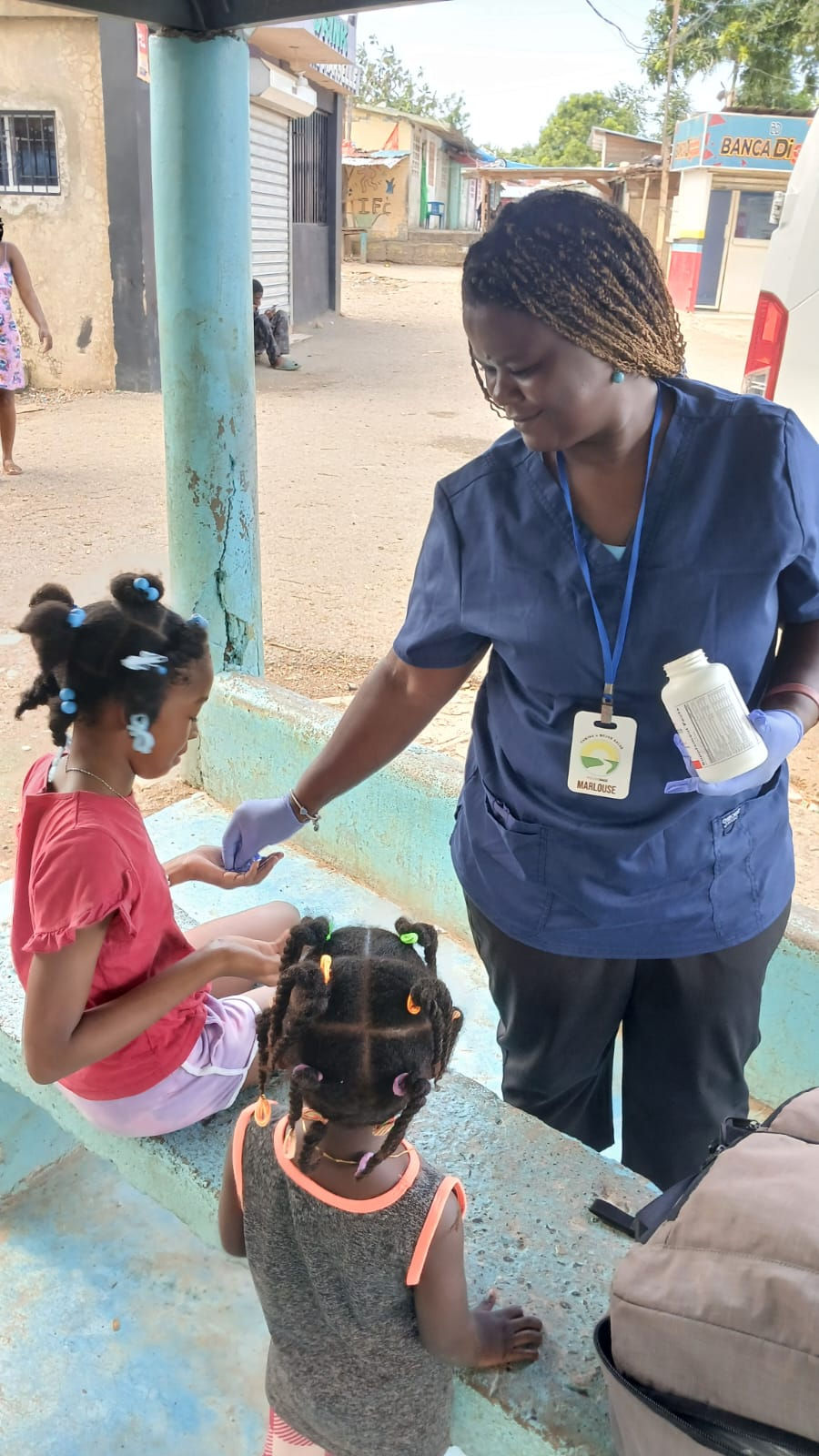
And just as importantly, she takes time to listen, encourage, and build relationships.
For people who often feel isolated or forgotten, having someone regularly show up at their door to check on them can mean so much.

Medical care isn't just about treating an illness. It's also about caring for the person.
We're deeply grateful to Bless Back Worldwide for their continued partnership in sustaining this program and helping us provide compassionate, consistent care to the communities we serve.

Update from Jonathan
For years, we have watched Haiti endure a level of violence, instability, and human suffering that is difficult to put into words. Armed gangs have expanded their control across significant portions of the country, terrorizing communities, disrupting daily life, closing schools, restricting access to healthcare, and making even the most basic activities dangerous for ordinary Haitians.
Families have been displaced. Children have been forced out of classrooms. Businesses have closed. Humanitarian organizations struggle to reach the very communities that need assistance most. And for many Haitians, the question has increasingly become not whether things will get better, but whether anyone is actually going to do something to make that possible.
Over the past several weeks, however, something significant has happened.
El Salvador enters the picture

El Salvador's President, Nayib Bukele, has become increasingly involved in the international effort to address Haiti's security crisis. Following years of implementing an aggressive anti-gang campaign in his own country, Bukele has now brought that approach, and a substantial military presence, to Haiti.
The immediate catalyst was a devastating ambush on October 18, when four Salvadoran military aviation technicians serving with Haiti's international Gang Suppression Force were attacked by armed gangs near Port-au-Prince. Their armored vehicle was struck by gunfire and explosives, and the four men subsequently disappeared. Their whereabouts became the focus of an increasingly urgent international search.
In response, President Bukele ordered a significant deployment of Salvadoran military personnel and equipment to Haiti. More than 2,000 Salvadoran troops have now been deployed or committed to the operation, including specialized forces and advanced military resources.

What initially began as an effort to locate and rescue the four missing personnel has increasingly evolved into something much larger: an expanded military campaign intended to confront the gangs and help restore security in Haiti.
Bukele has made his intentions clear. His government is prepared to take a much more aggressive approach to confronting the armed groups that have effectively established control over so much of Haiti.
The deployment has included heavily armed personnel, armored vehicles, helicopters, and other military resources. Operations are taking place alongside Haitian security forces and the international Gang Suppression Force, although questions remain about coordination, command structures, and the precise scope of the Salvadoran mission.
What has perhaps been most remarkable is the reaction among many Haitians.
After years of frustration, abandonment, and seemingly endless international meetings and promises, there is a growing sense of hope among portions of the Haitian population that perhaps this time something might actually change.

President Bukele has become a highly visible figure in this conversation. Videos circulating from Haiti show people welcoming Salvadoran troops, expressing support for the intervention, and openly celebrating the possibility that the gangs might finally face a force willing and equipped to challenge their control.
It is important to understand why this response is happening.
For years, ordinary Haitians have lived under the threat of armed groups that have operated with extraordinary freedom. People have watched their neighborhoods become inaccessible, their livelihoods disappear, their children lose educational opportunities, and their families become victims of kidnapping, extortion, and violence.
For many, the arrival of a substantial international military presence represents something they have desperately wanted to see: a serious effort to restore some measure of safety and allow people to reclaim their communities.
Some supporters have gone so far as to suggest that El Salvador has accomplished more in confronting gang violence in two weeks than the broader international community has managed to accomplish in years.

That is a powerful sentiment, although it is still too early to measure the actual results of this intervention or make meaningful comparisons. What is undeniable is that the scale and visibility of the response have changed the conversation.
For the first time in a long time, some Haitians are beginning to talk about the possibility of a future in which the gangs no longer dictate where people can go, whether children can attend school, or whether families can safely live in their own neighborhoods.
And that possibility, however uncertain, matters.
Please continue to pray for Haiti.
We ask for prayers for the leadership of El Salvador and Haiti, for the Salvadoran military personnel serving on the ground, for Haitian security forces, and especially for the millions of ordinary Haitians whose lives have been affected by this violence.
Pray for wisdom in decision-making, restraint in the use of force, protection for innocent civilians, and the courage to pursue a path toward lasting stability.
Pray that the four Salvadoran personnel who were taken in the October 18 ambush will be found and safely returned to their families.
And pray for the children and families who have spent far too long living in fear.
We don't know exactly what the coming weeks will bring. There are many unanswered questions, and it is entirely possible that this next chapter could be difficult, complicated, and at times dangerous.
But for the first time in a long time, there are Haitians who are looking toward the future with something they have had very little reason to feel in recent years: hope.
And we pray that this hope becomes something real — a safer Haiti, a stronger Haiti, and a Haiti where its people can once again live, work, learn, and raise their children without fear.


Comments