


Making Room for One Another
Sunday, January 4, 2026 - [click here to support the continuing work at MOHI]
Today's update is from Renée and Jonathan
As we step into a new year, I find myself reflecting on the invitation that January always seems to bring, not simply to do more, but to make room. Room for gratitude. Room for humility. Room for human beings. Room for God to move in ways we may not yet see or fully understand.
“Teach us to number our days, that we may gain a heart of wisdom” (Psalm 90:12). That prayer feels especially fitting as we enter 2026—aware of both the extraordinary joys and the sobering realities that shape life and ministry.
Lex and I are so grateful to be back in Luperón. Just yesterday, we welcomed a team of dear friends from Chair City Church (Gardner, MA), along with a few new faces. We are well on our way to a week filled with meaningful connections, learning, and shared experiences with our friends in the surrounding villages. There is something profoundly grounding about being together—about slowing down enough to listen, serve, and walk alongside one another.

Before I share more, I want to warmly welcome Jonathan back and invite you to reflect on his words, which beautifully capture the spirit of this season.
Welcome back, Jonathan. Thank you for offering this thoughtful reflection as we begin a new year:

On New Year’s Day 2026, walking through Miami International on my way back to Luperón, I watched two self-driving wheelchairs roll toward each other on Concourse D—like a game of chicken, or a dusty Western duel. One chair’s “smart” system announced, “Please move out of the way.”The other responded, just as firmly, that the first should “please move out of the way.” And there they sat—idle, frozen, facing one another, each insisting the other was the problem. I wondered if they’re still there.

As we “roll” into 2026 (pun intended), the moment felt less funny than instructive. Maybe the real invitation of a new year is to get out of the way—out of our own way. To step aside long enough to allow space for empathy, compassion, and hope to show up in real time, face to face. I couldn’t help thinking about how the very technologies designed to make life more efficient often thin out the connections that define what it means to be human. Watching those wheelchairs, I thought of the people who actually need them. I thought of the skycap or airport employee who would normally meet someone at the gate, guide them forward, reassure them that they were in the right place at the right time. What gets lost when that human presence is replaced by an automated voice repeating the same instruction? Maybe it was holiday nostalgia. Maybe it’s just age catching up with me. Or maybe it was the anticipation of returning to Luperón—to the Dominican Republic, to work that is slower, more organic, and still stubbornly human. Either way, those two wheelchairs, locked in a standoff, felt like a quiet parable for the year ahead: sometimes progress isn’t about moving faster—it’s about knowing when to step aside.
That posture—stepping aside so something deeper can emerge—was evident as the new year began in Haiti. The church was beautifully prepared, food was gathered, and hours were spent cooking in anticipation of a midnight feast.

Before the clock struck twelve, the congregation reflected on the year behind us, expressing heartfelt gratitude for the Lord’s provision throughout 2025. There was rejoicing through song and dance, prayers lifted, and Scripture shared to encourage one another. When midnight arrived, we entered the new year together in celebration of all that God has prepared for 2026, and for every resource needed: human, financial, intellectual, and supernatural.
January 1st also marks Haiti’s Independence Day. While it commemorates the birth of a nation, at its core it celebrates freedom from slavery—a declaration that no human being should ever be owned, diminished, or stripped of the right to determine who they are and who they may become. This truth is not limited to one people group or one chapter of history. The tragedy of slavery has touched many populations across the world, reminding us how fragile freedom can be and how essential it is to guard the dignity of every person.

That history of bondage and liberation gives deeper meaning to the everyday acts of care we are privileged to participate in now. Freedom is not only declared in moments of national significance; it is also affirmed in the simple, faithful work of loving one another well. This past week, children in the villages were fed and welcomed with joy, and through the generosity of local friends here in Luperón, we were able to share clothing and toys with families for the holidays. These offerings may seem small in the shadow of history, yet they speak powerfully of restoration—of people choosing compassion, community, and shared responsibility for one another.

In the midst of the meaningful and life-giving work we are privileged to do, there are also moments that stop us in our tracks. Scripture reminds us that “you are a mist that appears for a little time and then vanishes” (James 4:14). This week, we were painfully reminded of that truth.
A dear friend of MOHI here in the Dominican Republic—a young man known for his kindness, empathy, and deep sense of responsibility—was overwhelmed by despair following the deportation of his family. Already carrying the weight of providing for others far beyond his years, the loss of hope became unbearable, and he attempted to take his own life. By God’s mercy, someone entered the room just as he lost consciousness. Emergency responders were able to resuscitate him, and his life was spared.
We are profoundly grateful—and equally heartbroken. This is not a story about a statistic or an abstract issue. This is a real person, deeply loved, whose pain rippled far beyond himself. Situations like these remind us that displacement and loss are never just about changing an address. They fracture families, burden hearts, and can extinguish hope when support systems collapse. Please join us in praying for our friend, and for all of us at MOHI who are walking alongside him as he heals.
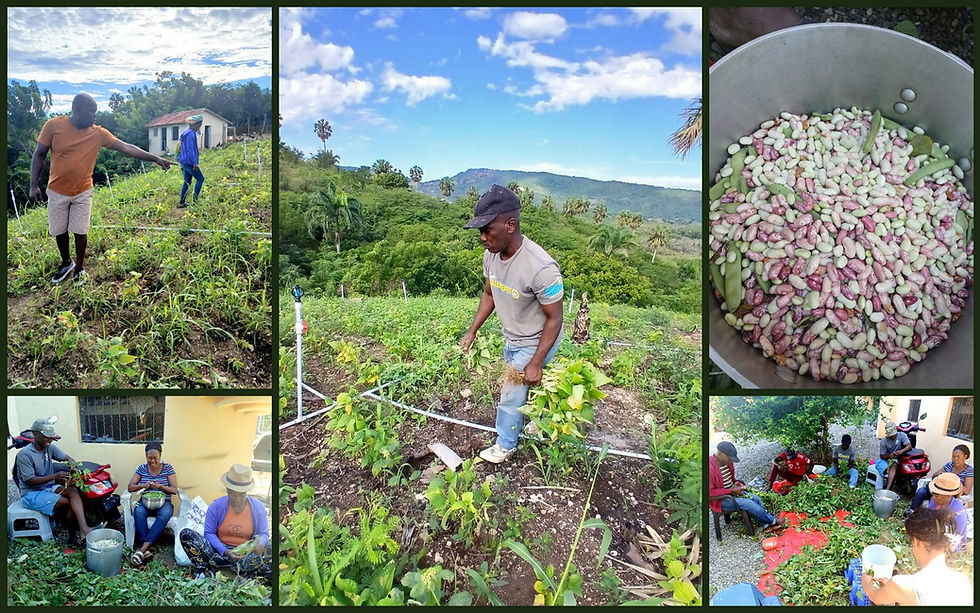
Amid these tender moments, there are also beautiful signs of provision and promise. It has been such a joy to watch food growing from the soil—beans, bananas, peppers, papayas, sugar cane, coconuts—nourishment that will be shared with our friends in the villages and with visiting teams. It is a tangible reminder that God continues to provide daily bread, often in quiet, steady ways.

We are also deeply thankful for our partnership with Bless Back Worldwide, whose collaboration allows us to strengthen medical and dental clinics and laboratory services in Haiti, and to support the Community Healthcare Promoter program in the Dominican Republic. Together, we are helping people understand what is happening in their bodies, access education and testing, receive accurate diagnoses, and—when needed—obtain life-saving care.

The team had the opportunity to worship in both Spanish and Haitian Kreyol this morning in churches that we partner closely with here in Luperón. It was exciting to see Micha and Eli share a couple of worship songs with the congregation, too.

After lunch, the team went to one of the villages to help feed the children and to have some good, old-fashioned fun!

Our hearts overflow with gratitude for every partner who walks this journey with us. Your prayers, generosity, encouragement, and trust make this work possible. We truly cannot do this alone. Every life touched, every meal served, every prayer lifted, and every seed planted reflects faithful partnership and shared obedience. It is a privilege to move forward together into the year ahead, and we wish each of you a truly happy and healthy new year—one marked by spiritual depth, physical strength, mental peace, restored relationships, and the faithful provision of all you need for the days ahead.


Comments