


“The Least of These”
Updated: Jan 31
Sunday, February 1, 2026 - [click here to support the continuing work at MOHI]
Today's update is from Taran and Jonathan
Jesus tells us plainly: “Whatever you did for one of the least of these brothers and sisters of mine, you did for me.”(Matthew 25:40)
Scripture speaks often—and clearly—about God’s heart for those who are vulnerable. In James 1:27, we are reminded that “religion that God our Father accepts as pure and faultless is this: to look after orphans and widows in their distress and to keep oneself from being polluted by the world.”
Later, in Matthew 25, Jesus paints a sobering picture of the final judgment. He describes a moment when humanity is separated like sheep from goats—not based on what people claimed to believe, but on how they lived. The dividing line was simple and deeply practical:Did you feed the hungry?Did you clothe the naked?Did you care for the sick?Did you visit the imprisoned?
Jesus and His disciples understood that love for God is inseparable from love for people—especially those most often overlooked. Care for the poor was never an optional expression of faith; it was central to it.
Because of partners like you, this calling is being lived out every day through Mission of Hope International.
Together, we are able to:
Feed more than 1,200 people daily
Provide medical care to hundreds each month
Offer education to over 800 children and students
Employ more than 50 local staff members
Support small business owners as they provide for their families
And so much more
Thank you for standing with “the least of these.” Thank you for being part of this God-honoring work.

Updates from the Dominican Republic
This past week in the Dominican Republic was a quieter one, with no visiting teams on site. We were grateful for the opportunity to move at a slower pace and were especially thankful to spend time with our friend Staci, whose visit brought encouragement and rest.
Medical check-ins continued through our community health promoter. Marlous shared how personally encouraged she was by the medical team that served the previous week, and how much that care continues to ripple through the community.

Mèt Ben also shared small but joyful moments from daily life—how much the children love meals that include eggs, bread with peanut butter, avocados, and bananas. It is always a gift to witness how something as simple as a consistent meal can bring so much joy and stability.

We are also thankful to share an encouraging update about Samy, who was hospitalized last month. We are grateful to see him in a much healthier place now. The Haitian and Dominican communities have surrounded him with care and compassion, and he is well enough to return to work. The children in our programs were especially excited to see him again—a reminder of the healing power of community and belonging.

Updates from Haiti
In Haiti, Lex was able to take a short trip to check in on the work and the team. Our staff shared how encouraged they were by his presence, and the children—and Lex—were all smiles as he helped serve food at the school.
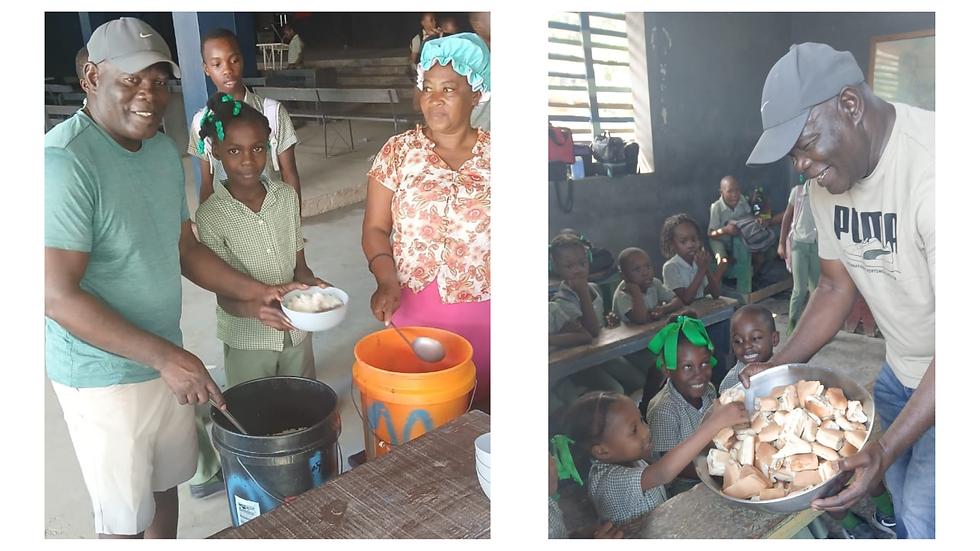
We were also thankful to welcome Gama, who spent time at the school leading a class with the youth. These moments of connection and teaching continue to shape both students and staff in meaningful ways.

Sun, Sea & Sisterhood – Women’s Retreat
Today is the final day to register.
Event Dates: February 26 – March 2, 2026
We are so excited for the group of women who will be joining us for Sun, Sea & Sisterhood—a time set aside for rest, renewal, worship, and meaningful connection.
There are still a few spots available if you would like to join us. We would love to welcome you for this empowering time of discovery in Christ, filled with fellowship, fun, refreshment, and restoration.

When the Pace Doesn’t Slow
Update from Jonathan
Since returning to Luperón on January 1, Mission of Hope International has been in constant motion. Teams have come and gone in steady rhythm, filling the Mission House with energy, laughter, logistics, and the beautiful chaos that comes with hosting people who have traveled far to serve. This past week, for the first time in a while, there was no HOPE Encounter here. I assumed—naively, it turns out—that the pace might slow. Fewer visitors, fewer schedules to juggle, fewer moving pieces.
I was wrong.
What shifted wasn’t the volume of work, but the shape of it. And in some ways, those quieter moments created space for some of the most meaningful encounters of all.
One of my greatest privileges of being here is fluency in Haitian Creole. Language opens doors—sometimes literally, often spiritually—and it has allowed me to connect more deeply with individuals in the community. In just a few short days without a team present, I’ve met new faces, heard stories marked by resilience and courage, and been entrusted with needs that demand action, not just empathy. These moments have clarified new objectives for me personally, especially as they relate to supporting those among us who are most vulnerable.
One such story weighs heavily on my heart. I am currently working to help secure medical treatment for a Haitian woman living here in the Dominican Republic who was diagnosed with breast cancer back in April but never sought treatment. Her situation is complex and painfully common. She is undocumented, which means that while emergency medical care is technically available, it comes with devastating consequences. Treatment is not free. And once a patient is medically cleared, arrest and deportation often follow.
We are cautiously optimistic about a path forward—hope made possible through a connection I first formed while living in Haiti in 2018, when I was advocating for a newborn girl in need of a liver transplant. It’s a reminder that seeds planted years ago, in moments of desperation and faith, can still bear fruit. And yet, it is sobering to confront how fragile access to care can be when immigration status determines whether compassion is extended without condition.
I’ve also found myself connecting with the boating and sailing community that calls Luperón home, at least seasonally. This bay—one of the most protected on the Atlantic—draws travelers from all over the world seeking safe harbor during hurricane season and the colder months up north. As a result, sailors fill the streets, cafés, bars, and shops of this small town. I’ve met fascinating people through this community, including a couple from Denver—less than 30 minutes from my own home in the U.S.
These friendships have introduced me to new worlds—sailing, maritime law, life lived between ports—and they’ve also revealed something deeply encouraging. This community is generous. Quietly, consistently, and often without recognition, sailors and boaters organize fundraisers for people in need, frequently Haitian families who are disproportionately impacted by aggressive immigration enforcement and racial discrimination. They also raise funds to care for stray animals throughout the community. While their mission may look different from ours, the heart behind it is unmistakably the same.
All of this brings me to something I feel is important to say clearly.
The Dominican Republic is often seen—and marketed—as a tropical paradise. And yes, there are stunning beaches, pristine coastlines, and moments of beauty that take your breath away. But it is also a country marked by deep and persistent poverty. I have worked in more than a dozen countries around the world, including some of the most devastated places on earth, and I can say without hesitation that the levels of suffering I’ve witnessed in certain areas of the Dominican Republic are among the most severe I have encountered.
When you support someone fundraising to participate in a Mission of Hope International HOPE Encounter, you are not funding a vacation. You are supporting human service, charitable, mission-aligned work. While team members may experience moments of rest—a shared meal, an afternoon near the water—their presence here is first and foremost about advancing the mission of MOHI. That work is clearly defined by our 501(c)(3) designation, and donations made directly to MOHI in support of missionaries are tax-deductible because they are just that: charitable contributions in service of others.
The work of Mission of Hope International cannot happen without you. Not without your generosity, your prayers, your advocacy, and yes—your willingness to come, to show up, and to be the hands and feet that do the hard work. Whether you support from afar or serve on the ground, you are part of the story unfolding here. And even when the pace doesn’t slow, hope continues to move—often quietly, sometimes unexpectedly—but always forward.


Comments